|
|
|
 |
The Bible
Mentions Sennacherib's Army Will NOT Set Foot in Jerusalem.
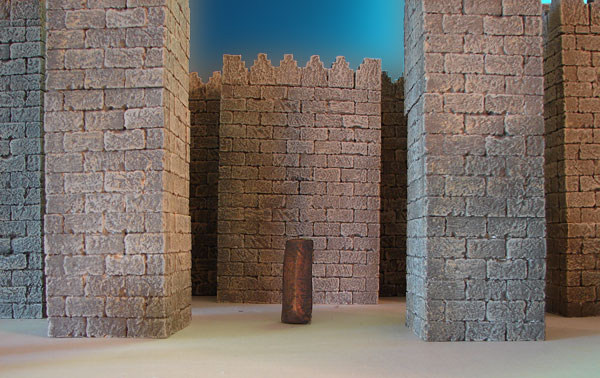
This miniature relief shows Sennacherib's Prism which records
the king's military campaigns. He boasts that he shut up
"Hezekiah the Judahite" within Jerusalem, his own royal city
like a "caged bird". The Bible mentions
this event in Isaiah 37:33-38. |
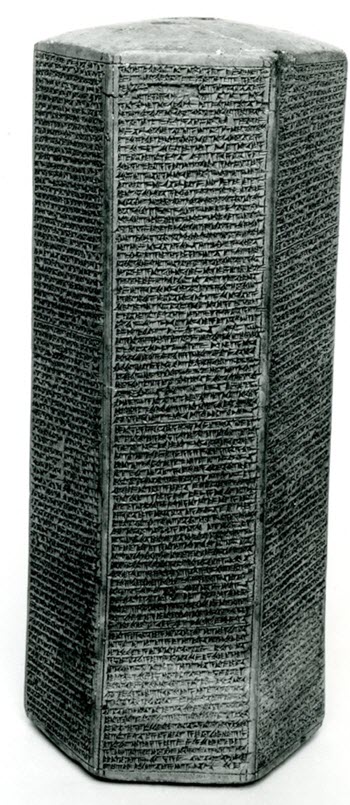
This miniature replica shows the 6-sided
prism of Sennacherib, king of Assyria. It records his victories and
never mentions any defeats. Sennacherib's army came against Jerusalem in
701 BC when Hezekiah was king of Judah. On the prism Sennacherib boasts
that he shut up "Hezekiah the Judahite"
within Jerusalem his own royal city "like a caged bird." This
prism (also known as the "Taylor Prism") is among the three accounts discovered so far which have been left
by the Assyrian king Sennacherib of his campaign against Israel and
Judah. The Prism is from the Palace of Sennacherib, king
of Assyria at Nineveh his capital. It is from the seventh century
BC. The original is located at the
British Museum. The Taylor Prism discovery remains one of the
most important discoveries in Biblical Archaeology.
Interesting note: Egyptian sources make mention of Sennacherib’s
defeat in the conflict with Judah, but gives the credit for the victory
to an Egyptian god who sent field mice into the camp of the Assyrians to
eat their bowstrings and thus they fled from battle.
(See 2 Kings 19; 2 Chronicles 32 and Isaiah 37)
"Therefore thus says the LORD
concerning the king of Assyria: 'He shall not come into this city, Nor
shoot an arrow there, Nor come before it with shield, Nor build a siege
mound against it. By the way that he came, By the same shall he return;
And he shall not come into this city,' Says the LORD. 'For I will defend
this city, to save it For My own sake and for My servant David's
sake.'" Then the angel of the LORD went out, and killed in the camp
of the Assyrians one hundred and eighty-five thousand; and when people
arose early in the morning, there were the corpses--all dead. So
Sennacherib king of Assyria departed and went away, returned home, and
remained at Nineveh." Isaiah 37:33-38

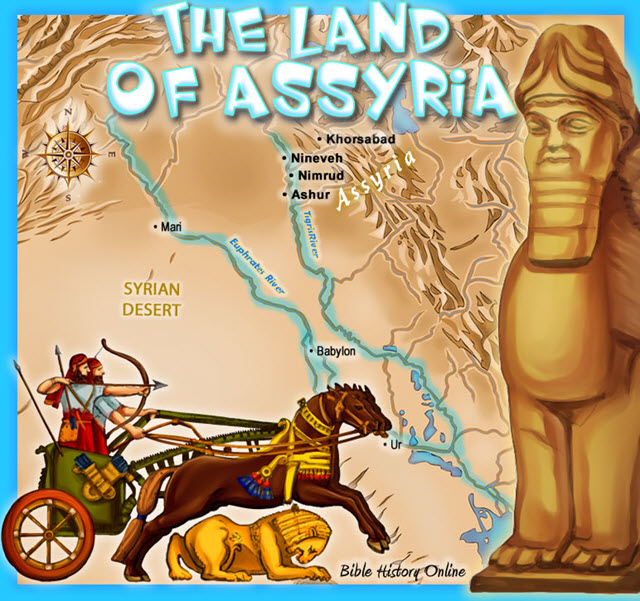
This map shows the primary capitals of the Neo-Assyrian Empire
Museum Images
Material - Baked Clay
Neo Assyrian (Reign of Sennacherib)
Language: Akkadian (Cuneiform)
Text: Records the first 8 campaigns of King Sennacherib
Date: 691 BC
Dates of Sennacherib's reign: 701–681 BC
Height: 38.5 cm
Width: 16.5 cm (max.)
Width: 8.57 cm (faces)
Depth:
Nineveh, northern Iraq
Excavated at Nebi Yunus
It was acquired by Colonel Taylor and Sold to the British Museum in 1855
Location: British Museum, London
Item: ANE 91032
Room: 69a, Temporary Displays
Biblical Reference: 2 Kings 18:13-19:37; Isaiah 36:1-37:38

British Museum Excerpt
The Taylor Prism
Neo-Assyrian, 691 BC
From Nineveh, northern Iraq
Recording the first 8 campaigns of King Sennacherib (704-681 BC)
This six-sided baked clay document (or prism) was discovered at the
Assyrian capital Nineveh, in an area known today as Nebi Yunus. It was
acquired by Colonel R. Taylor, British Consul General at Baghdad, in
1830, after whom it is named. The British Museum purchased it from
Taylor's widow in 1855.
As one of the first major Assyrian documents found, this document played
an important part in the decipherment of the cuneiform script.
The prism is a foundation record, intended to preserve King
Sennacherib's achievements for posterity and the gods. The record of his
account of his third campaign (701 BC) is particularly interesting to
scholars. It involved the destruction of forty-six cities of the state
of Judah and the deportation of 200,150 people. Hezekiah, king of Judah,
is said to have sent tribute to Sennacherib. This event is described
from another point of view in the Old Testament books of 2 Kings and
Isaiah. Interestingly, the text on the prism makes no mention of the
siege of Lachish which took place during the same campaign and is
illustrated in a series of panels from Sennacherib's palace at Nineveh.
The British Museum
British Museum Page
For the Oriental
Institute Prism of Sennacherib refer to the Bible History Online
article.
Information about Sennacherib's Prism
- Six-Sided Clay prism from the palace of
Sennacherib at Nineveh, his capital.
- Also referred to as the Taylor Prism after the man who purchased it.
- The prism records the first 8 military campaigns of Sennacherib
- Sennacherib reigned from 705-681 BC.
- It was discovered at Nineveh, Sennacherib's Palace and Capital City.
- The British Museum purchased it from Taylor's widow in 1855.
- Sennacherib's third campaign records the destruction of 46 cities in
Judah
- It mentions the deportation of 200,150 people
- The detailed cuneiform prism stands 38.5 cm tall.
- The 10 northern tribes of Israel had already been taken captive to
Assyria (722 BC)
- Sennacherib's west campaigns extended to the land of Judah
- Hezekiah was king og Judah during Sennacherib's reign.
- This prism is from the Neo-Assyrian Period (1000-612 BC).
- Excavated at the site of ancient Nineveh (Kuyunjik).
- His army was defeated at the gates of Jerusalem by the Angel of the
Lord
- Ancient Nineveh was excavated by Austen Henry Layard of Britain around
1849.
- This prism is currently at the British Museum.
- Nineveh (Kuyunjik) was Sennacherib's capital city (Northern Iraq).
 The Assyrian
Empire The Assyrian
Empire
The first great military empire in ancient history
was the Assyrian Empire. By the time of Ashurnasirpal and Shalmaneser
III in the 9th century BC the Assyrians organized a mighty army of
nearly 200,000 soldiers. Their military strategy was unsurpassed up to
that time, and with the age of iron they were an unstoppable fighting
machine. They brought spearmen, archers, shieldmen, slingers, siege
engines, chariots, and a huge calvary into the battlefield. The mighty
Assyrians dominated the ancient world until they were crippled by the
God of Israel in the reign of Sennacherib. God raised up the Assyrians
to remove Israel out of his sight for their rebellion and idolatry, but
the Assyrians would also be punished also for their wicked ways. They
finally fell to the Medes and Babylonians in 612 BC and passed into
history.
Assyrian Kings Mentioned in the Bible
2 Kings 15:29 -
In the days of Pekah king of Israel, Tiglath
Pileser king
of Assyria came and took Ijon, Abel Beth Maacah, Janoah, Kedesh, Hazor,
Gilead, and Galilee, all the land of Naphtali; and he carried them
captive to Assyria.
2 Kings 15:19 - Pul the
king of Assyria came against the land, and Menahem gave Pul one thousand
talents of silver, that his hand might be with him to confirm the
kingdom in his hand.
2 Kings 18:9 -
And it came to pass in the fourth year of king Hezekiah, which [was] the
seventh year of Hoshea son of Elah king of Israel, that Shalmaneser king
of Assyria came up against Samaria, and besieged it.
Isaiah 20:1 -
In the year that Tartan came unto Ashdod, when Sargon the
king of Assyria sent him,) and fought against Ashdod, and took it;
2 Kings 19:16 -
LORD, bow down thine ear, and hear: open, LORD, thine eyes, and see: and
hear the words of Sennacherib,
which hath sent him to reproach the living God.
2 Kings 19:37 -
And it came to pass, as he was worshipping in the house of Nisroch his
god, that Adrammelech and Sharezer his sons smote him with the sword:
and they escaped into the land of Armenia. And Esarhaddon his
son reigned in his stead.
Ezra 4:10 - and the rest
of the nations whom the great and noble Asnapper brought
over, and set in the city of Samaria, and in the rest of the country
beyond the River, and so forth, wrote.
Assyrian Kings Names in Cuneiform
Archaeology
of Ancient Assyria
Timeline of Ancient Assyrian Kings
(During the Period of the Biblical Kings)
Assur-nasirpal II (885-860
B.C.) A cruel warrior king, he made Assyria into the most fierce
fighting machine of ancient world.
Shalmaneser III (860-825
B.C.) His reign was marked by almost constant war. He was the first
Assyrian king to come into conflict with Israel. King Ahab fought
against him, and king Jehu paid him tribute in 841 BC. His royal
inscriptions were more detailed and more numerous than any other king.
His building works were massive just like his father Assurnasirpal II.
See Shalmaneser
and the Black Obelisk.
Shamsi-Adad V (825-808
B.C.) Most of his reign was focused on Babylonia and his own internal
conflicts.
Adad-nirari III (808-783
B.C.) The little information about his reign mentions his building
projects at Calah and Nineveh, as well as a conflict at Der in Babylonia
and collecting tribute in Damascus, Syria.
Shalmaneser IV (783-771
B.C.) The limited knowledge of his reign reveal some conflicts in
Damascus and a period of decline in Assyria.
Assur-dayan III (771-753
B.C.) The little information about this ruler reveals Assyria being in a
period of decline.
Assur-nirari V (753-747
B.C.) There is very little information about his reign. The king of
Urartu boasted of a victory over this king of Assyria in an inscription.
Tiglath-pileser III (Pul)
(747-727 B.C.) He restored Assyria to a major world power. He is the "Pul"
mentioned in the Bible and the one who began to destroy Samaria, the
capital of the Northern Kingdom of Israel. He carried many away into
captivity. This captivity is mentioned in his own inscriptions, the
Babylonian Chronicle, and the Bible.
Shalmaneser V (727-722
B.C.) He besieged Samaria, the capital of the Northern Kingdom of
Israel. He died during the siege after imposing taxation on the holy
city (Asshur), and his son Sargon came to power.
Sargon II (722-705
B.C.) He completed the destruction of Samaria and the captivity of
Israel. He was also famous for his magnificent palace with his colossal
winged guardians.
Sennacherib (705-681
B.C.) He was the most famous of the Assyrian kings. He mentions the name
of Hezekiah on his prism during his war campaigns, he claimed to have
"Hezekiah captured in his own royal city (Jerusalem) like a caged bird."
His army was defeated at the gates of Jerusalem by the Angel of the
Lord. Sennacherib returned back to Nineveh and was killed violently by
his own son, as mentioned in the Babylonian Chronicle, The Bible, and
various other inscriptions. He also conquered Babylon.
Esar-haddon (681-668
B.C.) He rebuilt Babylon, invaded and conquered Egypt by crossing over
the Sinai Desert with Arab camels carrying water for his army, and was
one of Assyria's greatest kings. He died fighting Egypt.
Assur-banipal (668-626
B.C.) He destroyed the Thebes in Egypt and collected a great library,
innumerable clay tablets were found.
Assur-etil-ilani (626-607
B.C.) It was under his reign that the Assyrian Empire fell.
Assyrian
annals mention contacts with some ten Hebrew kings: Omri, Ahab, Jehu,
Menahem, Hoshea, Pekah, Uzziah, Ahaz, Hezekiah, and Manasseh.
In the reign of Hoshea, king of Israel, Shalmaneser, king of
Assyria, twice invaded (2 Kings 17:3,5) the kingdom that remained, and
his successor Sargon II took Samaria in 722 BC, carrying away 27,290 of
the population as he tells in his Khorsabad Annals. Later Assyrian
kings, particularly Esarhaddon (681 BC - 668 BC), completed the task.
For More Info See:
Bible History Online
Map of the Land of Assyria
Kids Bible Maps
Primary Sources for Assyrian History
The Assyrian Annals. The scribes of the chief cities of the
Assyrians wrote the accounts of the king's military campaigns on
cuneiform tablets, and clay prisms or cylinders. The accounts are very
reliable, even though the accounts do not speak negatively of the
Assyrians and are meant to glorify the king. The annals also give much
detail to geography and Chronology. It is interesting how accurate the
Assyrians were with dates, they made use of an Assyrian Kings List or
the Eponym Canon.
The Assyrian Chronicles and Eponym Canon. The Assyrian scribes
organized their national events whether military, political or religious
every regnal year. The Babylonian Chronicles were structured the same
way. Assyrian records were kept very carefully, they took their dating
and their history seriously. They attached their record of events with
the solar year and with the name of an official who was known as the "limmu."
Their was a new limmu appointed every year. They recorded military,
political and religious events in every year and made references to
eclipses. The Assyrian records are highly dependable and allow Biblical
scholars a very accurate way of dating events and designating "eponyms"
for 244 year in Hebrew history, from 892-648 BC.
The Assyrian King List.
The Assyrian King List reveals a list of the kings of ancient
Assyria in chronological order, from the 2nd millennium BC to 609 BC. It
lists the name of the king, his father's name, the length of his reign,
and some great achievements.
Assyrian Sculptures. The limestone bas-reliefs discovered
from the palace walls of major Assyrian capital cities like Nineveh (Kuyunjik),
Nimrud (Calah), Khorsabad (Dur-Sharrukin), and the bronze bands on the
Balawat Gates reveal a wealth of history. The illustrative events were
carved be professional Assyrian artists like a modern day photographer
on the scene. The carvings reveal the military might and tactics of the
Assyrians, as well as the futility of those nations that defied their
might. These sculptures are on display in museums around the world, for
example: The British Museum in London, The Louvre in France, The Iraqi
Museum, and The Oriental Institute in Chicago.
The Bible. The Old Testament records the history of the Kingdoms
of Israel and Judah, along with the battles of other nations. It
includes the fall of the 10 tribes in northern kingdom of Israel in 722
BC by the Assyrians, as well as the
fall of the southern kingdom of Judah in 586 BC by Nebuchadnezzar of
Babylon. The Bible also records miraculous events surrounding people
like Elijah, and Jonah, as well as the slaying of 185,000 Assyrians at
Jerusalem by the Angel of the LORD. The events recorded in 2 Kings
generally agree with Assyrian and Babylonian sources. |